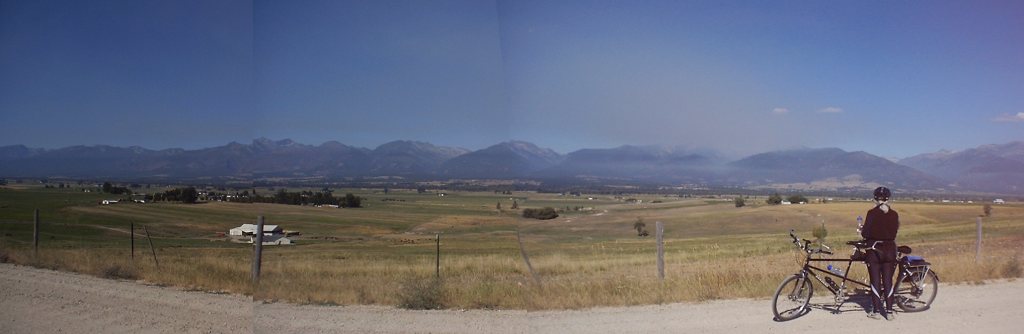
For those of you "back east" who think us Montanans a strange bunch anyway and those in Montana who have spotted Judy and me racing up and down the hills and highways in the Bitterroot Valley aboard "HPV Leviathan" (our Human-Powered Vehicle, a 1986 Santana fat-tired tandem bicycle, so christened many years ago by a coworker), a bit of explanation:
No, we aren't fitness maniacs or searching for lost youth. We are "in training" for the National Multiple Sclerosis Society's 2006 MS150 Bike Tour. While the event is hosted at various times in nearly each of the 50 states, for family reasons we choose to participate in the Washington State event, to be held this year on September 9th and 10th, in two 75-kilometer or 75-mile stages on hilly Fidalgo and Whidbey Islands and through the windy Skagit Valley. 800-1000 riders are expected to participate in the two-day event.
This will be our second year to participate in this very worthwhile event to raise awareness of MS and directly benefit research and patient programs through the generous donations of the participants and their friends. While we do enjoy bicycling as recreation, the arduous nature of the MS150 ride makes a clear statement that we do this in appreciation of the daily struggle many MS patients endure just to manage the necessities of life. We are very thankful to be able to remain physically active enough to even consider this level of effort.
Because our 30KG (nearly 70 pounds) bike is built as a mountain-style machine, for ruggedness and load capacity rather than speed, we ride the Metric version of the ride, covering the two 75K stages of the 150K course at our usual average speed of about 18KPH (a little over 11 MPH), which is not remarkable performance even for our ages (early 60s), but it is the best we can do with the equipment we have. The longer, 75 mile course is designed with lightweight road bikes in mind and average speeds over 12MPH. The shorter course ensures we can complete each stage in the 8-hour time limit with a comfortable margin for rest stops and mechanical problems. While we do exceed 50KPH on moderate downhill runs, and can sustain 35KPH on straight, level runs with a following wind, our drive train configuration and the inertia of the wide tires and heavy frame slow us down considerably uphill and in rolling terrain. In the last month or so, we have been increasing our riding to 100 miles a week, including weekend rides of up to 40 miles (65K) per day in the foothills, and this past weekend completed a relatively flat (less than 1000 ft total vertical gain) 50-mile (80K) ride up the valley to the village of Conner at the fork in the Bitterroot River and back, for the second time in the past month. I think we are ready.
While we do not actively seek sponsorship for our ride, having committed to meeting the minimum entry pledge goal ourselves, we do want to make people aware that the opportunity is there to support the work of the MS Society. The pledge website (links below) is open through the entire month of September. Reminder: all pledges go directly to support MS; the organizational costs of the bike ride itself is paid for by individual entry fees and corporate sponsorships.
To sponsor Larye's ride with an online pledge, or at least to see what geezers on bikes look like after two days of hard riding, click below:
To sponsor Judy's ride with an online pledge, click below:
Our team leader (and grandson Ethan's favorite aunt), Liz Hoffman, will again be able to ride with us, thanks to advances in early treatment for the symptoms of MS. This is really why we ride.
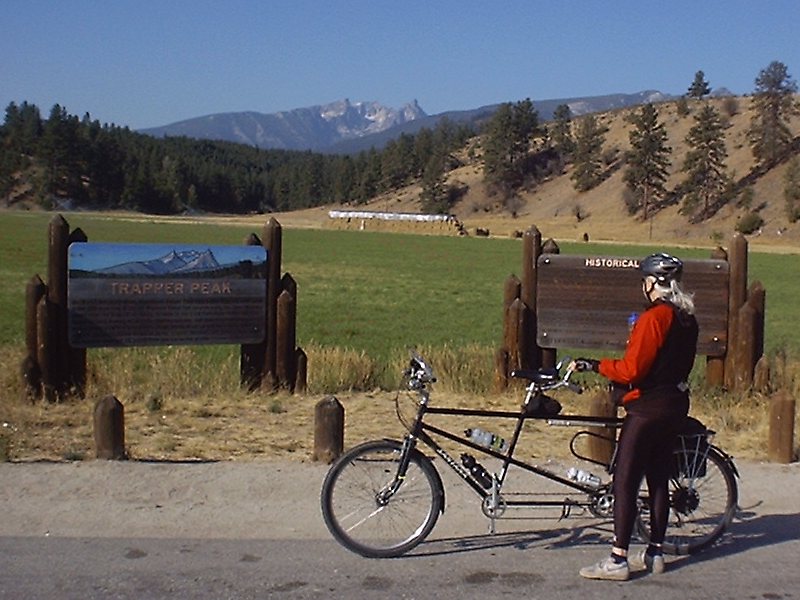
Statistics and bike facts: our top recorded speed was 85KPH (53MPH), on Pine Road on the Kitsap/Pierce county line in western Washington in 1987. In twenty years, we have ridden 'Leviathan' more than 5,000 miles, during which we have gone through at least five sets of tires, one rim, and a complete drive train overhaul (chainrings, chains, freewheel, and minor frame repair). Most of our riding has been during the first four and last four years, with a dozen years of occasional casual riding in between, during which we collectively gained, and then shed--in one year--a total of 190 pounds (related story here). Our longest daily ride was over 100 miles, from Seattle to Chehalis, Washington, the second longest being just under 100 miles the following day from Chehalis to Portland, Oregon, in June, 1987. Our longest sustained road trip was 450Km (275 mi), from Radium Hot Springs, British Columbia to Jasper, Alberta, in seven days, which included traversing four 2000-meter mountain passes, a few days after we rode the 50+ KM length of Going-to-the-Sun road in Glacier National Park, July 4, 1988, another 2000-meter pass with nearly 1000 meters elevation gain in 20Km (average 5% grade for 12 miles). Since we began riding regularly again in 2004, we have made numerous day rides of 50-100K (31-62 miles), in western Montana, the Idaho panhandle, and western Washington State.
About us: Larye started riding in 1976 and has since accumulated nearly 40,000 miles, mostly as a year-round bike commuter from 1976-1985 and 1996-present, in Rhode Island, western Washington, and western Montana. His longest daily ride was 200 miles, Seattle to Portland, Oregon, in 1983, and he has ridden in snow, sleet, hail, rain, and ice, from -28F to over 100F. Judy started riding seriously when we acquired the tandem in 1986, and is content to be the "stoker" half of the tandem team (the steersman, who is also in charge of the brakes and shifting, is called the "captain"). FAQs: Yes, we both pedal all the time, at the same rate: we have aligned the cranksets 90 degrees out of phase, with Larye leading, which makes for very smooth shifting and coordination of riders at the expense of accelerating power. I don't think we've ever seen this arrangement in any other tandem team--the usual configuration is with the pedals aligned in-phase--but it works for us and we've never tried any other settings. Our bike is older, but it has 18 "speeds" (3 chain rings and a six-gear freewheel), which gives us about 12 usable gear ratios to help maintain a constant pedaling rate of 65-80 RPM at speeds between 5 and 30 MPH. At a loaded touring weight of between 400 and 500 pounds, standard rim brakes are not sufficient--we also have a rear drum brake. Even so, the combination has failed us on one very steep downhill, fortunately with no cross traffic. Front and rear disc brakes are now appearing on newer bikes, as we have also had problems with tire overheating from excessive braking. Yes, despite being physically taxing, it is a _lot_ of fun. Between us, we have four left feet, so we don't dance, but, with our feet literally chained together, we do very well, on the road again. |
 |